
Kennesaw Climate & Local Conditions
Pine Pollen Season: What Yellow Dust Does to Your AC Condenser
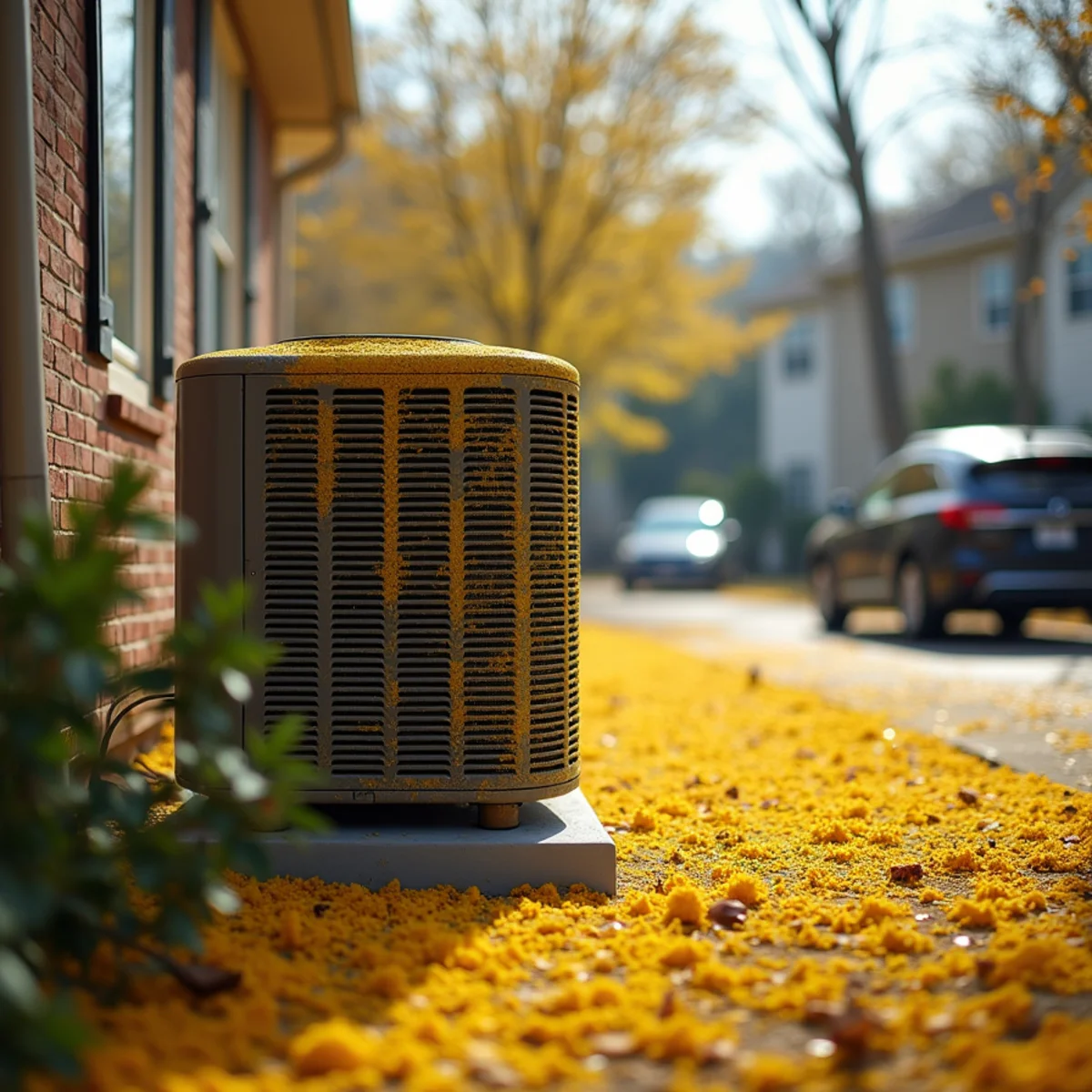
The yellow film is not just on your car
For a few weeks every spring, Kennesaw turns yellow. Loblolly and shortleaf pines release enormous clouds of pollen that settle on cars, porches, and pond surfaces. Cobb County sits in a heavily wooded part of metro Atlanta, so our pollen counts run high. You can rinse your driveway, but the part of your home that quietly suffers is the outdoor AC condenser, which spends pollen season pulling that yellow dust straight into its coil.
By the time the first real heat arrives in May, a condenser that breathed pollen all spring is already working harder than it should. Homeowners often call us in June about weak cooling, never connecting it to the pollen that came and went two months earlier.
How a condenser is supposed to work
Your outdoor unit, the condenser, is where heat from inside your home gets dumped to the outside air. The fan pulls air through a wraparound coil made of thin aluminum fins. Refrigerant inside those fins releases the heat it carried out of the house. The whole system depends on air moving freely across clean fins.
Anything that blocks that airflow forces the system to run longer and hotter to move the same amount of heat. Pollen is nearly the perfect blocking agent because it is fine, sticky when damp, and it packs into the tight gaps between fins where a garden hose spray from the outside cannot easily reach.
What pollen buildup actually costs you
A coil matted with pollen and the cottonwood fluff that arrives around the same time behaves like a clogged radiator. The effects stack up over a Georgia summer.
- Longer run times, so the AC struggles to hit the thermostat setting on hot afternoons.
- Higher head pressure, which stresses the compressor, the single most expensive part in the system.
- Warmer supply air and a house that never quite feels cool despite the unit running nonstop.
- Higher power bills for the same or worse comfort.
- In bad cases, a high-pressure trip or a compressor that overheats and shuts down.
Cleaning the coil the right way
You can do a basic condenser rinse yourself, and during pollen season it is worth doing. The key is going gently, because those aluminum fins bend if you look at them wrong, and a bent fin blocks airflow just like pollen does.
- Turn off power to the unit at the outdoor disconnect and the breaker before touching it.
- Clear leaves and grass clippings from around the base and the top fan grille.
- Using a regular garden hose, not a pressure washer, spray from the inside out if you can safely reach, or straight through the fins with a gentle stream.
- Rinse top to bottom and let the water carry the pollen down and out.
- Never use a pressure washer, a stiff brush, or bleach, which flatten fins or corrode the coil.
Why a rinse is not the whole job
A homeowner rinse handles the surface pollen, but it does not touch what packs into the middle of a multi-row coil, and it does not check the parts that pollen season stresses. That is what a professional maintenance visit adds. We open the unit, clean the coil fully with a proper coil cleaner, comb out bent fins, check the capacitor and contactor, verify refrigerant charge, and confirm the system is moving air the way it should. Doing this once a year, ideally right after pollen tapers off in late spring, sets the system up for the summer it is about to face.
Keeping pollen out in the first place
You cannot pollen-proof an outdoor unit, but you can reduce how much settles into it and stack the odds in your favor before the heat hits.
- Do not wrap or cover a running condenser with fabric or a fitted cover in summer. It traps moisture and pollen and starves the fan of air. Covers are for winter shutdown only.
- Keep shrubs, mulch beds, and pine straw at least two feet back from all four sides so air can reach the coil.
- Change your indoor filter more often during pollen season so the whole system runs cleaner.
- Give the coil a gentle rinse a couple of times during the worst pollen weeks.
Book the tune-up while the pollen is fresh in your mind
The cheapest way to survive a Georgia cooling season is to start it with a clean, checked system. If your condenser breathed a spring of Kennesaw pine pollen and you want it cleaned properly before the first 90-degree afternoon, HVAC Kennesaw GA can help. Call us at +1 (327) 210-5999 to schedule a maintenance visit, and we will get that yellow dust out of your coil before it costs you a compressor.
Frequently Asked Questions
Can I pressure-wash my AC condenser to blast off the pollen?
How much does pollen really reduce my cooling?
Should I cover my outdoor unit during pollen season?
Need a hand from a local Kennesaw HVAC tech?
Same-day service across Kennesaw & Acworth — 24/7 during ice storms and heat waves.
3600 Kennesaw N Ind Pky, Kennesaw, GA 30144